Skip to content
SCRM Guard · Knowledge & perspectives

Guard Spotlight.

What is shaping supply chains.
Concise updates. Informed analysis. Practical perspectives.

01 / CONCISE UPDATES

Supply chain briefing.

The week’s key developments. With context for procurement.

Original graphic in German. The article is available in English below.

SCRM Guard inLatest post

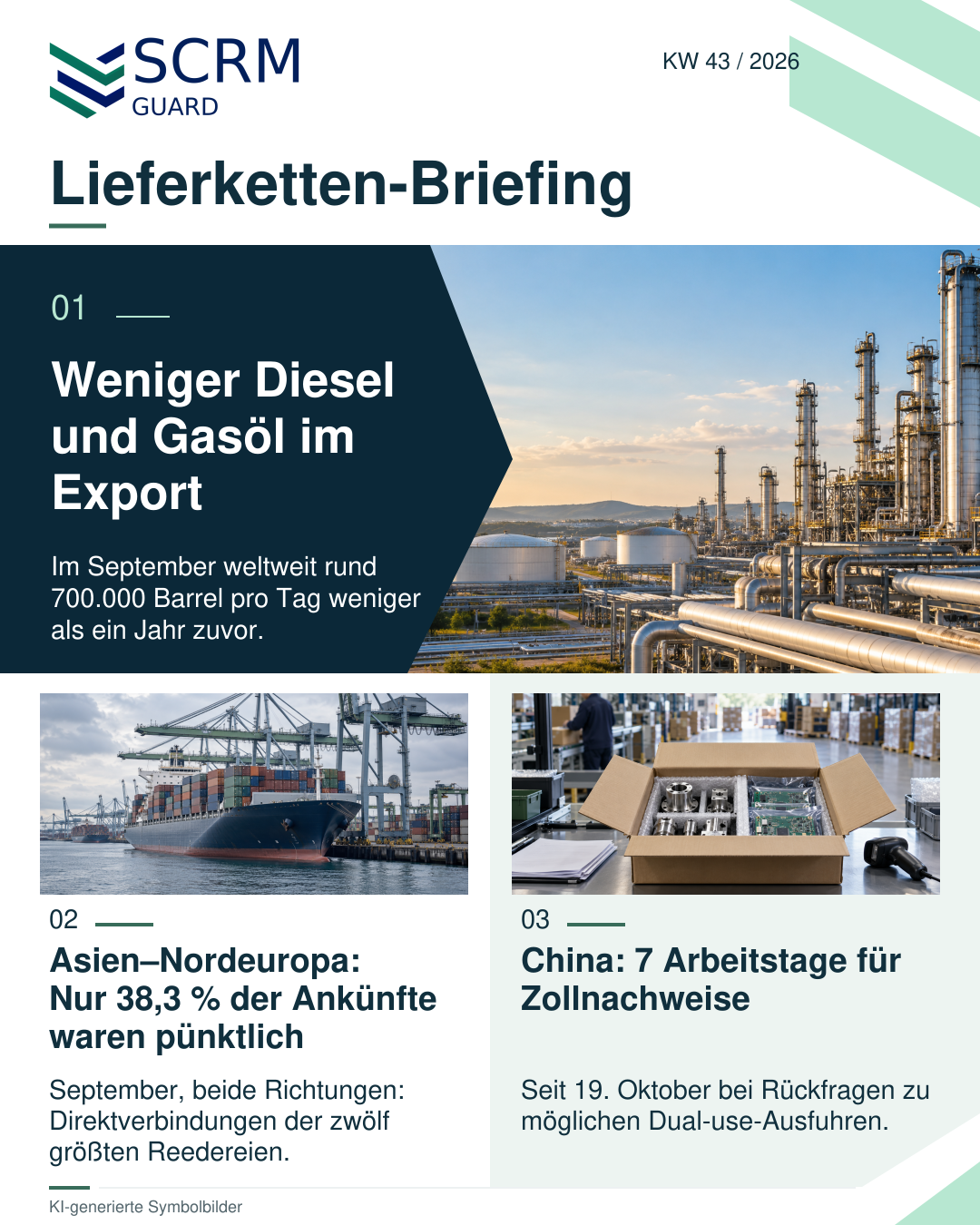
Supply chain briefing | Week 43

More crude oil, delayed ships and new documentation rules in China: these three developments matter for procurement and delivery planning this week.

01 | More crude oil, but lower diesel and gasoil exports
Global oil supply recovered significantly in September. Diesel and gasoil exports, however, were around 700,000 barrels per day below the same month a year earlier, according to the IEA report of 14 October. The agency expects the middle distillates market to remain tight well into 2027. For companies whose transport depends on diesel, this means discussing regional supply with carriers and when price changes will feed through into surcharges. Cheaper crude oil does not automatically mean lower transport costs.

02 | Many shipments between Asia and Northern Europe are arriving late
According to Kuehne+Nagel’s analysis of 15 October, 51.6 per cent of vessel arrivals worldwide were on time in September. Between Asia and Northern Europe, the figure was 38.3 per cent across both directions, down 3.4 percentage points from August. The analysis covers direct services operated by the twelve largest shipping lines; it does not establish when goods reach the factory. Companies sourcing critical parts via this route should therefore check their booked service and the time buffer before the parts are needed, rather than relying on the global average.

03 | China: Have documents ready for customs queries
China clarified its checks on possible dual-use exports with effect from 19 October. If customs raises a query, the exporter has seven working days to provide the required documentation. The affected goods will not be released until the matter is clarified. The rule is intended to facilitate existing procedures, rather than impose a blanket restriction on new exports. For critical orders, it is worth confirming the classification of the goods and the technical documents with the supplier before shipment. Additional queries or checks can take time, even where the procedure specifies fixed deadlines.
SCRM Guard in

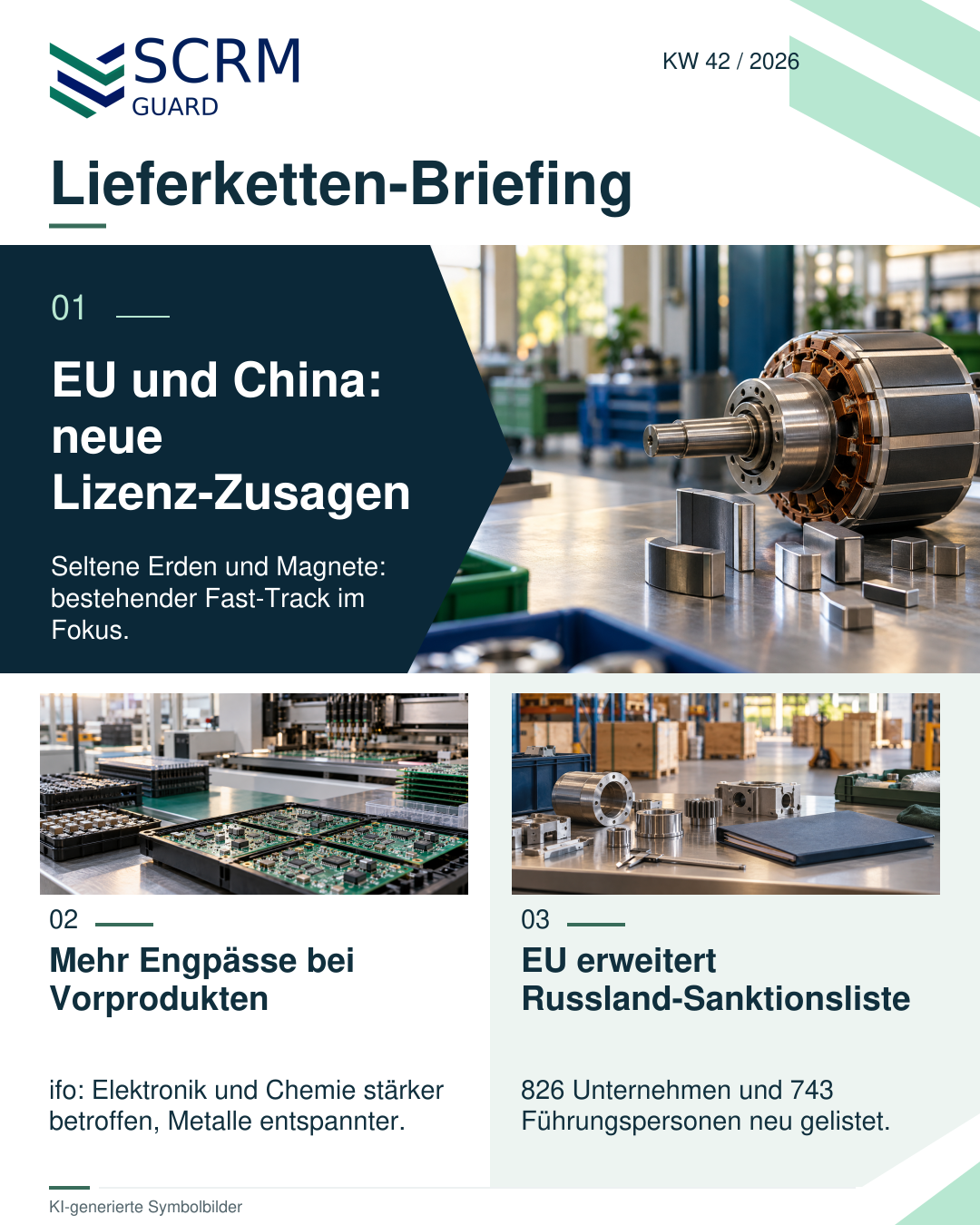
SCRM Guard supply chain briefing | Week 42

New commitments from China, more material shortages in parts of industry and additional EU sanctions: three developments for procurement.

01 | China intends to further facilitate export licences
In the joint statement of 9 October, China agrees to further facilitate licences for rare earths and permanent magnets shipped to the EU through the existing fast-track procedure. [1] This matters for manufacturers of motors and drives and their suppliers. It does not yet establish shorter lead times. Review outstanding licence applications with suppliers and adjust delivery plans only on the basis of specific approval and shipping confirmations.

02 | Material shortages are rising again
According to the ifo publication of 12 October, 14.6% of German industrial companies lacked intermediate goods in September, up from 13.3% in August. The figure was 37.8% for electronics and optical products; the chemical industry also reported more shortages. In basic metals, by contrast, the situation eased. [2] Your own bill of materials is what matters: check confirmed delivery dates and stock coverage for critical components, rather than increasing inventory across the board.

03 | EU expands Russia sanctions list
On 12 October, the Council added 826 Russian companies and 743 executives to its sanctions list. They include suppliers of electronics, communications technology and optics. [3] Listed parties are subject to asset freezes and a ban on the direct or indirect provision of economic resources. Procurement and compliance teams should incorporate the updated lists into business partner screening and have possible indirect links reviewed before pending transactions proceed.

Sources:
[1] https://ec.europa.eu/commission/presscorner/api/files/document/print/en/statement_26_2122/STATEMENT_26_2122_EN.pdf
[2] https://www.ifo.de/fakten/2026-10-12/materialengpaesse-der-industrie-nehmen-wieder-zu
[3] https://www.consilium.europa.eu/en/press/press-releases/2026/10/12/russia-s-war-of-aggression-against-ukraine-eu-agrees-largest-ever-package-of-listings-targeting-almost-1600-individuals-and-entities-in-russia-s-military-industrial-complex/

SCRM Guard in

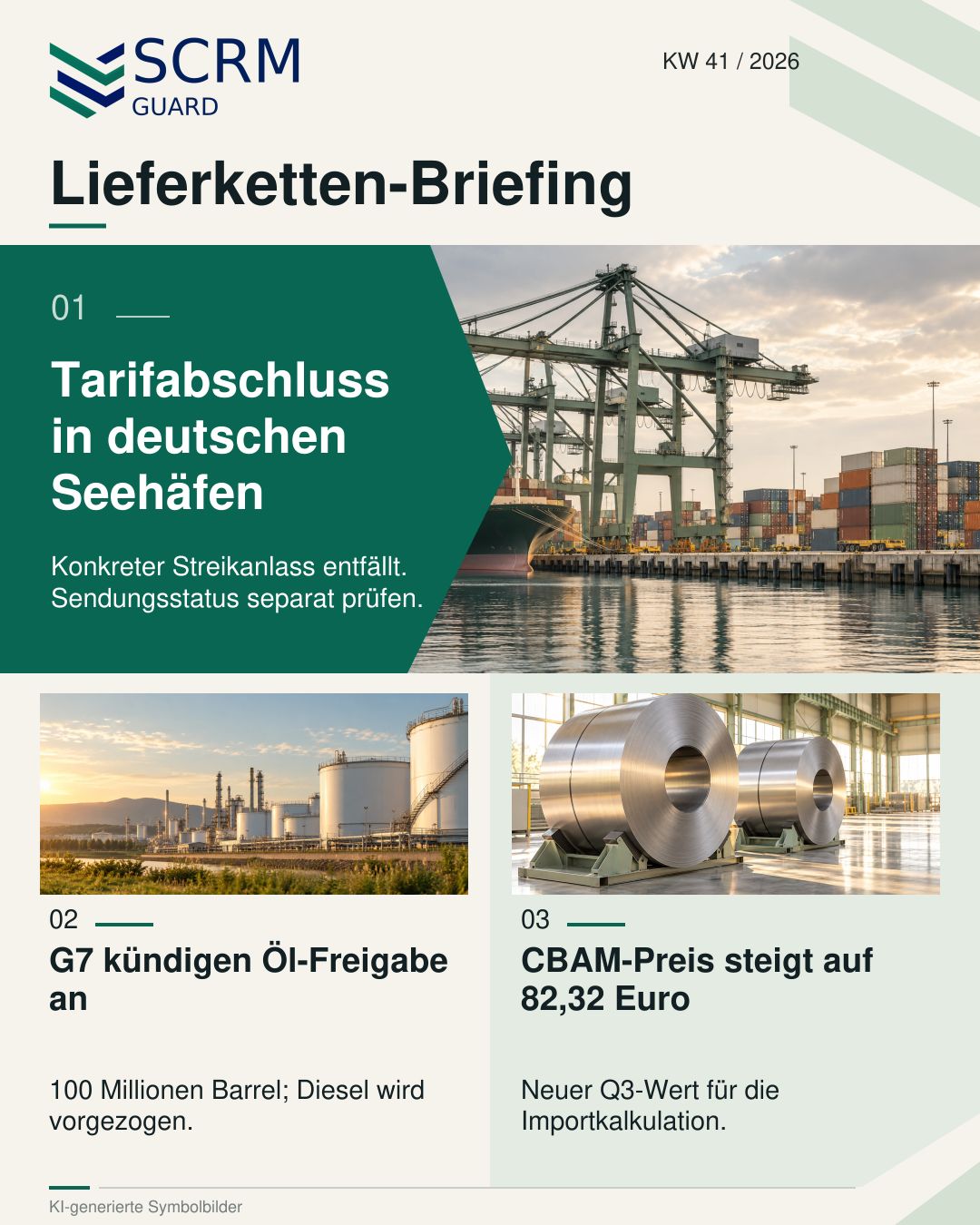
SCRM Guard supply chain briefing | Week 41

A port labour agreement, an announced oil reserve release and higher CO₂ costs: three developments for procurement.

01 | Collective agreement at German seaports
ZDS and ver.di have reached an agreement, as confirmed by the employers’ association on 6 October. It covers employers bound by the collective agreement in Hamburg, Bremen/Bremerhaven, Emden, Brake and Wilhelmshaven. [1] This removes a specific potential cause of strike action affecting import and export supply chains. Companies that had planned to use alternative ports as a precaution should reassess that diversion with their logistics partner. Whether individual shipments remain delayed still needs to be checked separately; a collective agreement does not confirm available terminal capacity.

02 | G7 announce release of oil reserves
On 2 October, the G7 announced the release of 100 million barrels over four months, with part of the diesel allocation brought forward into the first 20 days. [2] For companies heavily reliant on road freight, the key question is when any relief might be reflected in transport costs. Check the reference index and adjustment frequency of diesel surcharges. The announced release is evidence of neither freight rates having already fallen nor transport capacity being secured.

03 | CBAM: Q3 price rises to €82.32
On 5 October, the European Commission published the certificate price for Q3 2026: €82.32 per tonne of CO₂e, up from €75.28 in Q2. [3] This changes the cost basis for affected steel and aluminium imports. Procurement and customs teams should bring together Q3 import volumes, emissions data and cost assumptions. The actual liability also depends on the applicable adjustments; the certificate price alone is not a surcharge per tonne of material.

Sources:
[1] https://lnkd.in/e-ee7UgD
[2] https://lnkd.in/e7YsBwZW
[3] https://lnkd.in/dJNftifj

AI-generated illustrative images; not documentary photography.

Swipe right for older posts.

Post 1 of 3
02 / A CLOSER LOOK

Analysis in focus.

Selected events · Evidence-based context
How we select and assess events

Only when it matters.

We focus on events with far-reaching consequences for supply, transport or production.

Clear, traceable analysis.

Confirmed facts, possible consequences and open questions remain clearly distinguishable. Sources and the information date are included.

A practical perspective.

Each analysis shows which dependencies companies can examine and which developments could change their decisions.

03 / AROUND GUARD

The latest from Guard.

News, ideas and insights into our work.

Original graphic in German. The article is available in English below.

SCRM Guard inLatest post

Österreichisches EinkaufsForum 2026

Today and tomorrow, SCRM Guard is attending the BMÖ’s Österreichisches EinkaufsForum in Vienna.

“Uncertainty remains. The ability to act can be built.”

Under this title, Manuel Brauch and Philipp Rathjen will demonstrate tomorrow how companies can address risks in their supply chains and remain able to act. SCRM Guard provides operational support for procurement: identifying and assessing risks, and progressing concrete measures.

You can find us at the Gallery Walks on 15 October between 12:00 and 13:15 in The Den at The Hoxton Vienna.

If you are there too, come and say hello. We look forward to the conversation!

#Procurement #SupplyChains #SCRMGuard